How the camcorder ended up in every 1980s living room
The camcorder boom transformed family memories by turning a bulky, two-piece studio rig into an all-in-one recorder that changed home life forever.
Yarden Cohen · 1 October 2026 · 5 min read

The camcorder arrived in living rooms because manufacturers combined a video camera and a tape recorder into one single, portable unit. Before that breakthrough, capturing home movies with sound required lugging a heavy camera wired to a bulky deck slung over your shoulder. Once companies squeezed both machines into one handheld case, recording daily life changed from an expensive, silent hobby into an everyday habit.
The heavy burden of early home video
To understand why the camcorder felt so revolutionary, you have to look at what parents used before it arrived. Through the previous decades, family memories belonged to 8mm film reels. Film had rich color, but it came with severe trade-offs. It carried no sound, ran for only three minutes per roll, and required days or weeks of waiting for a processing lab to develop the reel.
When early consumer video systems emerged in the late 1970s, they brought immediate sound and instant playback. Yet using them was a physical workout. You held a heavy video camera against your eye, tethered by an umbilical cord to a separate portable videocassette deck strapped across your chest. The battery lasted less than an hour, and the combined rig weighed as much as a bowling ball. Following a toddler running through the yard meant managing tangled wires while balancing awkward weight across both shoulders.
As explored in the history of the home video camera, engineers spent years trying to eliminate that connecting cable. The goal was straightforward: build a machine that could record light, sound, and tape inside a single chassis.
The race to shrink the machine
The breakthrough happened in the early 1980s. Sony launched the Betamovie, introducing the combined word camcorder to everyday speech. By shrinking the internal recording mechanisms, the camera accepted a standard full-size tape right inside its body. It rested securely on the shoulder, freeing the user from any external deck.
That first model had one clear limitation. It was record-only. To watch what you had just filmed, you had to eject the cassette and carry it over to the standalone player hooked up to your television.
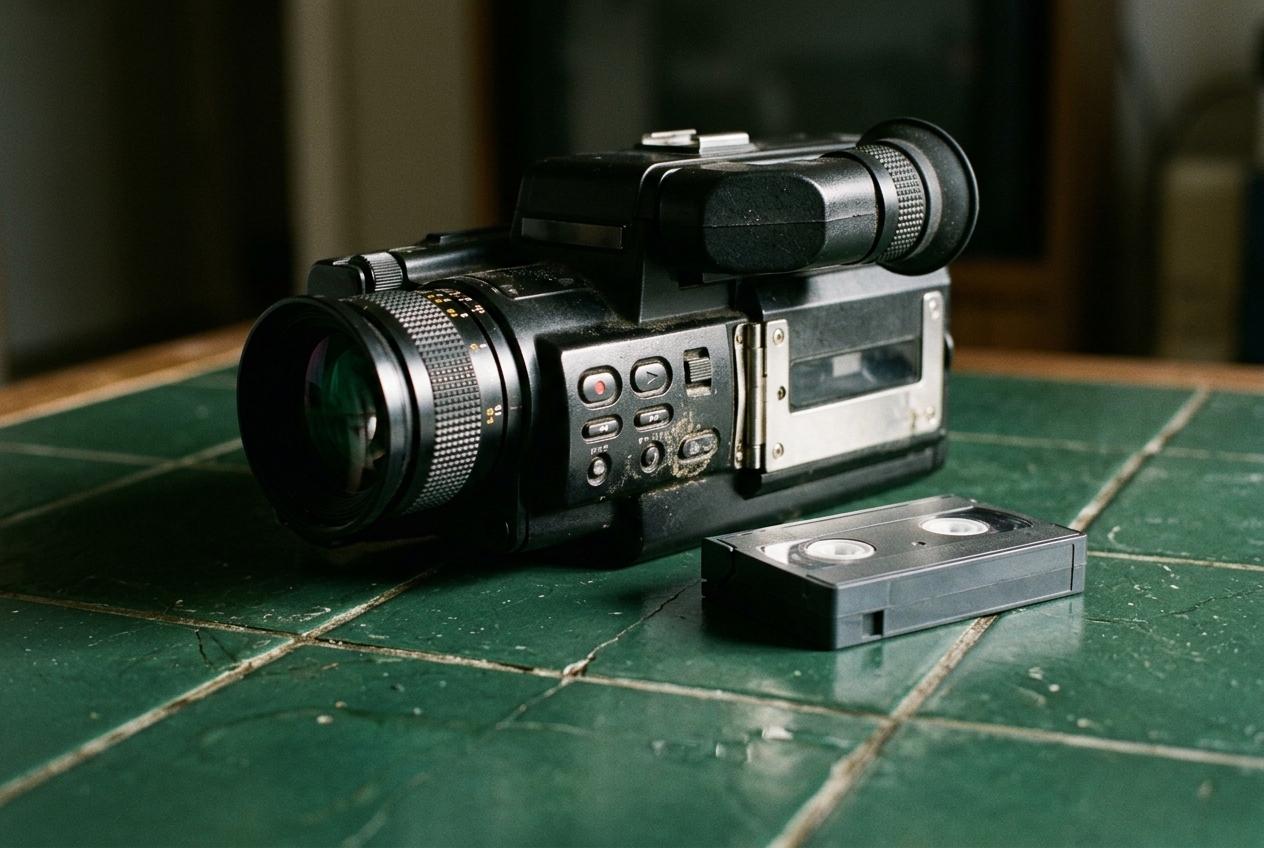
Soon after, rival engineers at JVC introduced the GR-C1, which used a smaller cassette format called VHS-C. This design allowed the camera body to shrink to a fraction of the size. Crucially, it included an electronic viewfinder that let you play back the footage immediately on location, rewinding right in the eyepiece. Competition between electronics makers escalated quickly, sparking a retail war that transformed home recording.
Why the tape boom exploded
As manufacturing improved, retail prices fell from luxury territory into middle-class household budgets. By the late 1980s, an all-in-one video camera became a standard fixture for birthdays, recitals, and summer vacations.
More importantly, recording media became affordable. A roll of film had cost real money for every few minutes of footage, forcing parents to be extremely conservative. They pressed the trigger only when the birthday candles were burning or when a graduate walked across the stage. A video cassette, by contrast, offered up to two hours of continuous recording for a modest price.
Because hitting record cost practically nothing, parents stopped waiting for formal milestones. They filmed ordinary Saturday mornings: children eating cereal in pajamas, someone vacuuming the rug, dogs chasing garden hoses, and long, unscripted conversations around the kitchen table. The camcorder turned home archiving into an unfiltered document of domestic routine.
The stance that defined a decade
The physical form of these cameras created a recognizable visual style. Even compact units were dense and heavy compared to modern smartphones, demanding steady two-handed operation.
Parents learned a posture that defined home video aesthetics:
- The shoulder rest. The rear of the camera chassis nestled firmly against the front of the right shoulder to bear the weight.
- The grip strap. The right hand slid through a padded strap, resting the index finger on the zoom toggle and the thumb directly on the red start-stop button.
- The lens cradle. The left hand held the underside of the lens barrel, steadying the horizon and occasionally adjusting manual focus.
This two-handed posture led to smooth, slow pans across living rooms. The cameraman turned their entire torso rather than flicking their wrists. It gave 1980s tapes their distinct visual signature: deliberate tracking shots, prolonged lingering on relatives' faces, and sudden, dramatic zoom-ins on awkward smiles.
Formats in the family closet
By the end of the decade, living rooms split across three competing tape formats, each bringing distinct practical trade-offs:
- Full-size VHS: Large and heavy on the shoulder, but completely hassle-free after filming. You popped the tape out of the camera and pushed it straight into your standard deck under the television.
- VHS-C: Much smaller and easier to carry. To play the tape on the television, you had to insert the compact cassette into a motorized adapter shell. Anyone looking to convert VHS-C to digital today often needs to track down a working adapter before playback is possible.
- Video8: A compact cassette developed by Sony that produced crisp images in small camera bodies. Because the tape did not fit standard players, viewing required plugging the camera directly into the front inputs of the television using color-coded cables.
The shelf life of magnetic tape
The camcorder boom left behind millions of hours of family history sitting in shoe boxes, attics, and hallway closets. Yet magnetic tape has an unavoidable natural limit.
The binder material holding the magnetic particles onto the plastic backing ribbon deteriorates over time. Tapes recorded decades ago frequently exhibit color drift, muted audio, and horizontal static tracking lines. Digitizing stops physical decay from progressing further, though it cannot turn standard analog tape into modern studio clarity. The soft focus and gentle tape hiss are simply part of the authentic texture of that generation.
Once those tapes are digitized, a practical challenge emerges: unedited home video is exhausting to watch. Parents let the tape roll for hours across uneventful rehearsals, carpet views, and road trips. When gathering everyone for an event, sorting through those massive files can quickly overwhelm the person in charge. If you are preparing an anniversary or birthday gathering, Linof can repair and colorize old photographs, animate a photo into a short moving shot, and assemble your selected pictures and video clips into a polished short film with music and titles, with your first photo animation free to try.
Rescuing the voices and rooms
The true legacy of the 1980s camcorder boom is that it captured the sound of daily life. For generations before, our ancestors survived only as silent, stiff poses in photo albums. The camcorder preserved the unvarnished reality: the distinctive laugh of a grandparent, the clatter of pots in a kitchen, and the ambient noise of a household that has completely changed.
If you have a collection of tapes resting on an upper shelf, pull them down. You can learn how to choose photos and videos for your film by focusing on those short, genuine moments rather than trying to watch every hour of raw tape. Those dusty plastic cassettes hold the living voices of your family, ready to be heard again.
Questions
Why were 1980s camcorders so heavy?
Early camcorders had to house a full motorized tape transport mechanism, large battery packs, and glass zoom lenses inside one shell. Even after eliminating the separate deck, consumer electronics relied on heavy metal and plastic components that required two-handed operation.
Can I watch 1980s camcorder tapes on a modern TV?
You can watch them if you have a functioning camcorder or VCR with analog RCA outputs connected to an analog-to-digital adapter on your modern screen. A more durable approach is digitizing the cassettes onto a modern drive or storage device so you can view them without old playback hardware.
Do camcorder tapes degrade over time in storage?
Yes, magnetic tape degrades naturally through binder breakdown, moisture, and demagnetization over several decades. Digitizing old tapes preserves the recorded audio and video before the tape ribbon suffers from permanent flaking or signal loss.
Written by
Yarden Cohen