The history of the home video camera
A look back at how heavy tape decks and shoulder mounts evolved into the compact camcorders that captured our childhoods.
Yarden Cohen · 1 October 2026 · 6 min read

The history of the home video camera is the story of shrinking technology and expanding family archives. It began with silent film reels sent off to laboratories, moved through heavy two-piece systems carried on shoulder straps, and settled into the handheld camcorders that recorded countless birthdays, holidays, and school plays across the late twentieth century. Each change in gear changed what people decided to film, transforming private documentation from a stiff, rare ritual into an ordinary part of daily life.
The early days of mechanical home movies
Before magnetic tape existed, capturing moving images at home meant shooting on narrow photographic film. In the middle of the twentieth century, formats like regular 8mm and later Super 8 brought motion pictures to ordinary households.
A typical cartridge or spool held only about three minutes of footage. Film was expensive to buy and cost even more to develop, so the person holding the camera had to be selective. They filmed the cake being brought out, the baby taking three steps, or the family waving from the front porch before the shutter button was released to save footage. Most early home cameras recorded no audio. When the processed reel came back in the mail, family members gathered in a darkened room, set up a noisy mechanical projector, and watched their lives flicker quietly on a pull-down screen or a bare white wall. For households working with surviving reels today, digitizing Super 8 film requires dedicated frame scanning to capture those silent frames before the acetate base warps.
The two-piece portable video recorder
In the 1970s, magnetic video recording moved out of broadcast television stations and entered consumer living rooms. The dream of recording sound and picture together without waiting for chemical processing had arrived, but the physical setup was demanding.
Early portable video setups were not single devices. They consisted of two separate pieces connected by a thick cord:
- A handheld video camera equipped with a lens, a handle, and a tiny black and white electronic viewfinder.
- A heavy portable videocassette deck slung over the shoulder with a wide nylon strap.
- A lead acid battery pack that drained quickly under continuous shooting.
Carrying both units across a backyard or through a park required genuine effort. The heavy shoulder pack swung with every step, and the battery gave out quickly. Even so, the ability to film a birthday party with sound, walk directly into the living room, and plug the tape into a television set made the physical weight worth carrying.
The birth of the one-piece camcorder
In the early 1980s, engineers solved the problem of separate components by combining the camera and the recorder into one housing. The single unit was christened the camcorder.
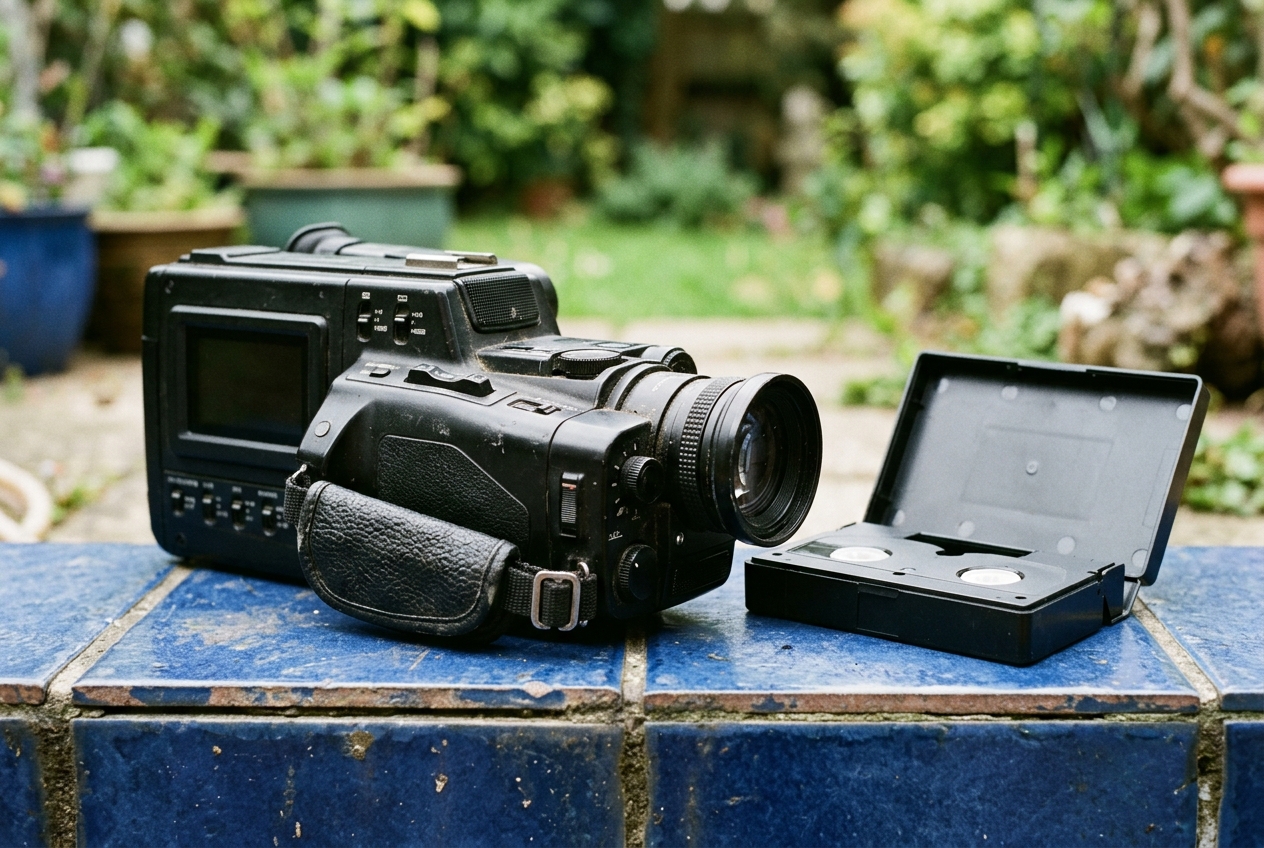
These first-generation camcorders recorded directly onto full-size VHS or Betamax cassettes. Because the housing had to accommodate a standard video cassette, the machines were massive. They were designed to rest on the operator's right shoulder, balanced by a padded base, while the hand slipped into a leatherette side grip. Looking through the tiny rubber eyecup, the operator controlled optical zoom rockers and focus dials manually.
The real breakthrough was convenience. As soon as the recording was finished, the cassette could be popped out and inserted directly into the living room VCR. There were no conversion boxes or tangled patch cords. The shoulder mount camera quickly became the centerpiece of weekend sports games, weddings, and holiday mornings. Learning how to store old VHS tapes properly has since become essential, because the delicate magnetic tape used in these heavy machines decays when kept in humid closets or attics.
Compact cassettes and the living room documentary
Manufacturers soon realized that smaller equipment would lead to more filming. To shrink the size of the camera, they had to shrink the cassette inside it. This led to compact analog formats, primarily VHS-C and Video8.
A VHS-C cassette was essentially a miniature VHS tape that held twenty to thirty minutes of high-speed recording. After filming, you placed the small cassette inside a motorized plastic adapter shaped like a standard VHS tape, and inserted that adapter straight into your living room VCR. Video8, designed around an eight-millimeter magnetic tape, held more time in a cassette barely larger than an audio tape.
Because cameras were now compact enough to hold in one hand, filming became casual. People stopped reserving the camera for landmark ceremonies. They began recording Tuesday dinners, rainy afternoons building block towers, and long, lazy car rides. This period created the bulk of the videotapes found in storage boxes today. Converting VHS to digital often means working through these compact cassettes, uncovering hours of unfiltered family dialogue that silent film could never capture.
The digital era: MiniDV and the flip screen
By the late 1990s, the analog era gave way to digital recording with the introduction of MiniDV. The tapes were tiny, about the size of a matchbox, allowing the cameras to slide into a winter jacket pocket.
MiniDV brought two major improvements that changed how families documented their lives:
- High quality digital capture: Unlike analog tapes, which gained noise and lost sharpness whenever they were copied, MiniDV stored digital information that looked sharp through repeated playback.
- The flip-out color screen: Instead of squinting through an eyecup with one eye closed, operators could open a rotating liquid crystal screen. Parents could film from waist level or hold the camera above a crowd, and the children being filmed could immediately look at their own playback.
By the mid-2000s, physical magnetic tape began to disappear entirely. New models recorded directly onto mini-DVDs, miniature hard drives, and eventually flash memory cards. The familiar mechanical hum of the tape transport motor went quiet.
The smartphone shift and saving past footage
The standalone home video camera vanished from everyday life once smartphones gained dependable video recording. With a camera always present in every pocket, parents no longer needed to plan ahead, charge spare batteries, or carry specialized gear on outings. The volume of recorded moments surged, but the physical ritual of gathering around a tape recorder came to an end.
Decades of family history now sit inside plastic shells in basements and drawers. Magnetic tape oxidizes, stretches, and loses signal over time. Preserving those moments requires converting the physical media into modern video files before playback hardware disappears.
When you digitize an archive of old tapes and photos, the raw footage can feel overwhelming to sort through. Linof turns a family's photos and videos into a short film with music, titles, and restored moments, and your first photo animation is free. The result brings order to hours of tape and gives everyone a reason to watch together.
What to look for on your old equipment
If you find an old home video camera in storage alongside a stack of recordings, inspect it carefully before attempting to run a precious tape through the mechanism:
- Check the battery compartment: Old nickel-cadmium or early lithium packs often leak white powder or swell. Clean the compartment thoroughly and power the unit using its direct wall adapter instead.
- Inspect the tape door: Gently open the cassette door to make sure the internal loading arms move smoothly without grinding.
- Examine the heads: Decades of dust can gum up the internal spinning video drum. Running a cleaning tape through the transport can prevent the mechanism from chewing through an irreplaceable family recording.
If the camera powers up and outputs a signal, you can connect its analog ports to a capture device. If the mechanism sticks or squeals, stop immediately to avoid crinkling the tape inside. The goal is simple: rescue the pictures and voices captured during those decades of shoulder packs and handheld tapes, and make them watchable for the family again.
Questions
What was the very first home video camera?
The first consumer home video systems appeared in the late 1960s and 1970s, using separate portable tape decks wired to hand cameras, known widely as Portapaks. The true one-piece consumer camcorder arrived in 1983, integrating the camera and recorder into a single shoulder-mounted body.
Why do old home video tapes lose quality over time?
Videotapes store images and sound using magnetic particles glued to a plastic ribbon. Over twenty to thirty years, that chemical binder absorbs moisture and breaks down, which causes tape flaking, color fading, and static lines across the screen.
How can I tell which camcorder format I have?
Examine the size of the tape and the compartment door. Full VHS tapes are the size of a paperback book, VHS-C and Video8 cassettes are roughly the size of a deck of cards, and MiniDV tapes are as small as a matchbox.
Written by
Yarden Cohen